Filter by

How Perceived Value Mediates Muslim Consumer Loyalty to Halal Cosmetics: An A…
Introduction: Community productivity is critical in maintaining quality of life to avoid disasters. The use of digital technology in the economic aspect has also provided opportunities for people far from the market to earn income to meet their living needs. Objective: This quantitative study aimed to explore the impact of halal labeling, price, and product quality on consumer loyalty toward In…
- Edition
- Vol. 6 No. 02
- ISBN/ISSN
- 2442-3076
- Collation
- -
- Series Title
- -
- Call Number
- -

Pengaruh Fitur Muslim Friendly terhadap Perilaku Pelanggan Airbnb (The Impact…
This research aims to analyze the influence of halal attributes, such as halal social environment, halal facilities, halal food and beverages, and services and staff of hotels or guesthouses, which are grouped into one variable, namely cognitive assessment, on consumer intention to visit, consumer willingness to pay, and WOM through Affective Assessment.
- Edition
- Vol 5, No 3,
- ISBN/ISSN
- 2716-0807
- Collation
- -
- Series Title
- -
- Call Number
- -

MAQASHID SHARIA AND CUSTOMER DECISIONS IN ISLAMIC HOUSING FINANCE: EVIDENCE F…
The purpose of this study is to analyze maqashid sharia, namely dharuriyat proxied by service quality, hajiat proxied by location, and tahsiniyat proxied by promotion on customer decisions in the FLPP program in Islamic Banking in West Java. This study uses a quantitative approach. The primary data collection technique uses a questionnaire. The sampling technique used is purposive sampling. The…
- Edition
- Vol. 5 No 2
- ISBN/ISSN
- 2774-2687
- Collation
- pp. 164-181
- Series Title
- -
- Call Number
- -

Implementasi Konsep Syirkah Al Amlak dalam Akad Al Musyarakah Al Muntahiyah B…
This research aims to understand the implementation of the syirkah al amlak concept in the al Musyarakah Al Muntahiyah Bi al Tamlik (MMBT) agreement on Sharia fintech purchase order (PO) financing products at PT Alami Fintek Sharia. The method used in this research is a qualitative method, based on a case study and interview approach, combining library research. The results of the research show…
- Edition
- Vol 8, No 2
- ISBN/ISSN
- 25978829
- Collation
- PP.1864-1880
- Series Title
- -
- Call Number
- -

Criticisms The Government's Role of Zakat Regulation in Indonesia for Improvi…
This research aims to analyze previous research trends regarding Sharia credit cards and the sentiment of this research regarding law from an Islamic perspective. This research is a literature review that uses secondary data from 55 articles related to Sharia credit cards on Dimensions.ai. The data analysis techniques used are meta-analysis, bibliometric, and sentiment analysis, which are proce…
- Edition
- Vol.5, No.1
- ISBN/ISSN
- 27217090
- Collation
- PP.191-210
- Series Title
- -
- Call Number
- -
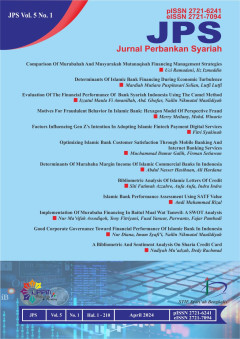
A BIBLIOMETRIC AND SENTIMENT ANALYSIS ON SHARIA CREDIT CARD
This research aims to analyze previous research trends regarding Sharia credit cards and the sentiment of this research regarding law from an Islamic perspective. This research is a literature review that uses secondary data from 55 articles related to Sharia credit cards on Dimensions.ai. The data analysis techniques used are meta-analysis, bibliometric, and sentiment analysis, which are proce…
- Edition
- Vol.5, No.1
- ISBN/ISSN
- 27217090
- Collation
- PP.191-210
- Series Title
- -
- Call Number
- -

THE INFLUENCE OF THE APPLICATION OF MAQASHID SHARIA ON CUSTOMER DECISIONS IN …
The purpose of this study is to analyze Maqashid Sharia, specifically dharuriyat (necessities) proxied by service quality, hajiat (complementary needs) proxied by location, and tahsiniyat (embellishments) proxied by promotion, on customer decisions within the FLPP program in Islamic banking in West Java. This study adopts a quantitative research approach. Primary data were collected through a s…
- Edition
- Vol 5, No 2, 2024
- ISBN/ISSN
- 27742687
- Collation
- pp.164-181
- Series Title
- -
- Call Number
- -

DETERMINANTS OF STUDENT ETHICAL BEHAVIOR: A STUDY ON ISLAMIC ACCOUNTING EDUCA…
"This study aims to analyze the impact of Islamic accounting education and the level of religiosity on ethical behavior. All variables were measured using questionnaire instrument which were distributed to 53 undergraduate students majoring in Islamic accounting located in Java. The hypotheses were tested using multiple regression analysis. The results shows that Islamic accounting ed…
- Edition
- Vol. 10 No. 1, Year 2024
- ISBN/ISSN
- 2502-4159
- Collation
- pp.39 – 52
- Series Title
- -
- Call Number
- -

THE IMPACT OF THE FORWARD-LOOKING EXPECTED LOSS METHOD REFERS TO FINANCIAL AC…
This research investigates the effect of applying the forward-lookingexpected loss method as a consequence of Financial AccountingStandard (FAS) No 71 on earnings quality. Since the technique iseffective in 2020, forward-looking expected loss is measured using loan loss provisions ratio with a year dummy to differentiate forward-lookingand non-forward-looking…
- Edition
- Vol. 7(1), 2024
- ISBN/ISSN
- 2685-1059
- Collation
- pp.35 - 50
- Series Title
- -
- Call Number
- -
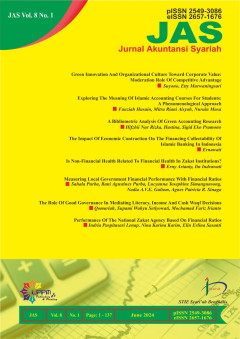
A Bibliometric Analysis Of Green Accounting Research
The primary goal of green accounting is to address social issues impacting global sustainable development and to influence corporate actions towards social and environmental concerns. This research aims to map the concept of green accounting and describe its impact on science. This research is a literature review using bibliometrics. Bibliometrics …
- Edition
- Vol 8 No 1 (2024)
- ISBN/ISSN
- 2657-1676
- Collation
- pp.37-53
- Series Title
- -
- Call Number
- -
 Computer Science, Information & General Works
 Philosophy & Psychology
 Religion
 Social Sciences
 Language
 Pure Science
 Applied Sciences
 Art & Recreation
 Literature
 History & Geography